FULL DOCUMENT IN PDF – SPANISH
FULL DOCUMENT IN PDF – ENGLISH
ABOUT THE OPEN CALL
1. What is the Cáceres 2031 Open Call?
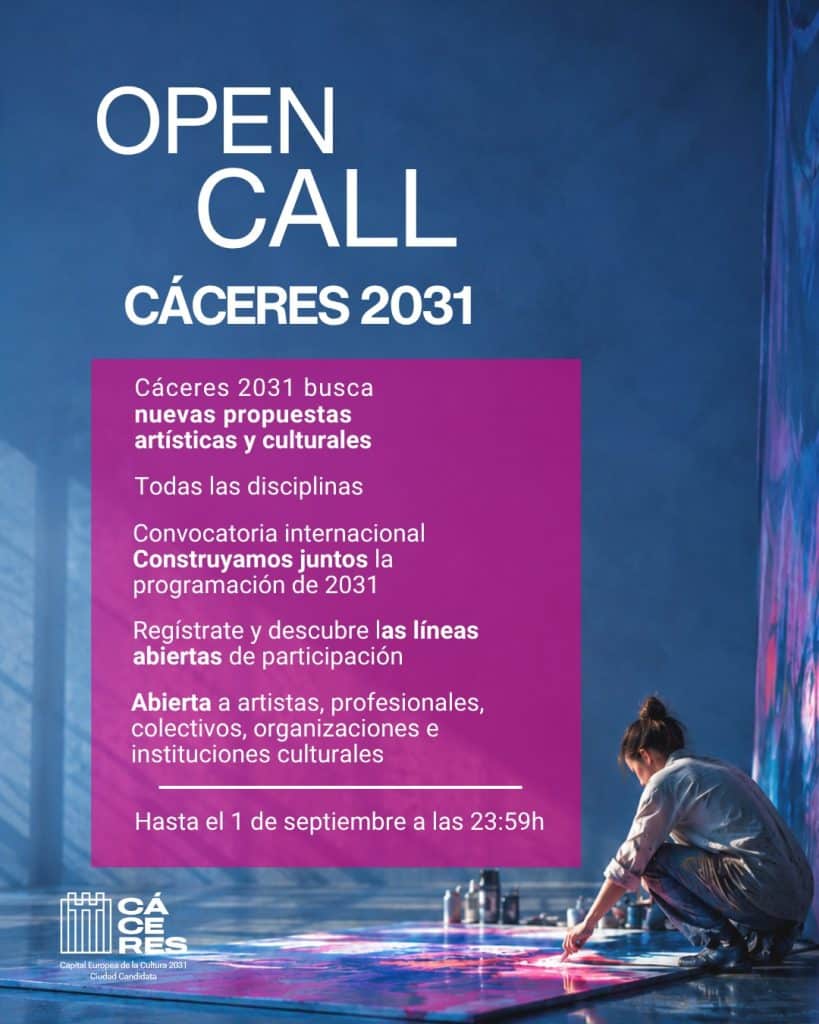
It is an open call to identify artistic and cultural projects that could complement the programme of Cáceres’ bid for the title of European Capital of Culture 2031.
It is neither a general call for ideas nor a call for grant applications. We are looking for proposals with a distinct identity and genuine potential for development which, if selected, can evolve through collaboration between their creators and Cáceres 2031, with a view to their possible inclusion in the programme.
2. Why is this Open Call being launched now?
Cáceres 2031 is entering a new phase in the development of its bid. The artistic programme already includes numerous projects currently in development, but we have identified areas in which we would like to incorporate new proposals, perspectives, artistic disciplines, territories and European collaborations.
The Open Call provides an additional way to complete and enrich the programme.
3. Does the Open Call replace dialogue with the cultural sector?
No.
No. Dialogue with the cultural sector began in 2025 through meetings, sector-specific sessions and conversations with artists, associations, institutions and other cultural stakeholders. This dialogue is continuing throughout the current phase of the bid.
The Open Call serves a different purpose: to enable new projects to be considered for inclusion in the artistic programme.
4. Is this a grant call?
No.
No. There is no fixed amount of funding that will automatically be awarded to each selected project. This is a process for selecting and developing projects
If a proposal is selected, Cáceres 2031 will work with the project team to jointly define its final scope, timetable, budget, funding model, production arrangements and conditions for development.
WHO CAN TAKE PART
5. Who can submit a project?
The Open Call is open to:
artists and other creative practitioners, cultural professionals, companies, collectives, associations, cultural organisations, institutions, public and private bodies, and interdisciplinary teams.
Specific eligibility requirements may vary depending on the strand under which the project is submitted.
6. Are projects from all artistic disciplines eligible?
Yes.
Yes.
The Open Call is organised around thematic areas rather than artistic disciplines.
Pueden presentarse, entre otras, propuestas de:
Proposals may encompass, among others, visual and fine arts; painting, sculpture, photography and installation; theatre, dance and circus; music and sound art; film and audiovisual work; literature and oral practices; architecture and design; crafts; digital creation and video games; art, science and technology; heritage; public art; community-based cultural practices; education and cultural mediation; and interdisciplinary practices.
7. Why are there no separate categories for painting, fine arts, music, theatre and other artistic disciplines?
Because the categories in the Open Call are not based on artistic disciplines.
A visual arts project may explore memory, climate, equality or technology. A performing arts project may be created for children. An installation may form part of a collaboration between Extremadura and Portugal.
Projects may use any artistic discipline or combination of disciplines; the strands define the areas of research, creation or engagement addressed by each project.
PARTICIPATION LINES
8. Which strands are open?
The Open Call comprises seven strands:
Cross-border Creation: Extremadura–Portugal
and six thematic strands:
- – Democracy, Memory and Participation
- – Art, Science and Technology
- – Live Arts and Public Space
- – Children and Educational Communities
- – Feminism and Equality
- – Climate and Territory
9. What if my project falls under more than one thematic strand?
You should select the thematic strand that best represents the project’s main focus. Submitting a proposal under one strand does not prevent it from addressing other themes or issues.
Cáceres 2031 may subsequently consider how the project connects with other areas of the programme.
10. Can I submit more than one project?
Yes, provided that each submission is a different proposal. A separate registration must be completed and the corresponding form submitted for each project.
THE INITIAL REGISTRATION FORM
11. Why is there an initial registration form before the project-specific form?
The initial registration allows us to organise incoming proposals and direct each project to the most appropriate form. This ensures that our teams can subsequently work with information that is both comparable and manageable.
12. What happens after I complete the initial registration?
Based on the information you provide, you will receive an email containing a link to the project-specific form that applies to your proposal. I
f you indicate that the project involves genuine collaboration between partners from Extremadura and Portugal, you will receive the Cross-border Creation form.
In all other cases, you will receive the form corresponding to your selected thematic strand.
13. I have not received the second form. What should I do?
First, check your inbox and spam or junk folder, and make sure that the email address you provided is correct.
If you still have not received the form, please contact Cáceres 2031 at makers@caceres2031.org so that we can check your registration and send you the appropriate form.
THE SPECIFIC FORMS
14. Why do the forms ask for so much information?
Because we are not simply collecting ideas at this stage. Selected projects may become part of the artistic programme for Cáceres’ bid for the title of European Capital of Culture 2031. We therefore need sufficient information to assess both their artistic quality and their genuine potential for development.
We do not expect every proposal to be fully developed. We are looking for enough information to understand its potential and assess its feasibility.
15. Does my project need to be fully developed?
No.
No.
Projects may be submitted at different stages of development: research, development, prototyping or production. Existing projects seeking to evolve or take on a new dimension are also eligible.
What matters is that the proposal is sufficiently well defined for us to understand its artistic identity, objectives and potential for further development.
16. Can an existing project be submitted?
Yes.
Yes.
You may propose the further development, adaptation, expansion, co-production or contextualisation of an existing project, provided that there is a clear rationale for developing it in the context of Cáceres 2031.
CÁCERES, EXTREMADURA AND EUROPE
17. Does the project have to take place in Cáceres?
Not necessarily, and it does not have to take place there exclusively.
Cáceres is the candidate city, but the bid has a strong regional dimension encompassing Extremadura as a whole.
Depending on their nature, projects may take place in Cáceres, in other municipalities across Extremadura, in rural areas or in different European territories. They may also combine several geographical scales.
Depending on their nature, projects may take place in Cáceres, in other municipalities across Extremadura, in rural areas or in different European territories. They may also combine several geographical scales.
18. Why does the form ask how the project relates to Cáceres or Extremadura?
Because we are looking for projects that are relevant to this particular bid. We want to understand the kind of dialogue the project could establish with the territory, its communities, forms of knowledge, landscapes, challenges and cultural context.
19. Do I need to have European partners already confirmed?
It depends on the project.
The European dimension is fundamental to a bid for the title of European Capital of Culture. However, not every project needs to have all its international partners confirmed from the outset.
You may also indicate the type of European organisation that the project would need to involve at a later stage.
20. What do we mean by the European dimension?
It does not simply mean inviting an artist from another country.
We are particularly interested in projects involving co-creation, co-production, joint research, mobility, knowledge exchange, residencies, collaboration between communities, the circulation of works and participation in networks, as well as projects that explore questions or challenges shared by Extremadura and other European territories.
CROSS-BORDER CREATION EXTREMADURA-PORTUGAL
21. What do we mean by “cross-border creation”?
This strand is intended for projects conceived through genuine collaboration between partners from Extremadura and Portugal.
It is not enough for a project from Extremadura simply to invite a Portuguese participant on a one-off basis, or vice versa.
We are looking for projects in which responsibilities, creative processes, activities or outcomes are shared between partners in both territories.
22. Can a cross-border project involve partners from other European countries?
Yes.
Yes.
Collaboration between Extremadura and Portugal is the starting point for this strand, but the project may also involve partners from other European territories.
AUDIENCES AND PARTICIPATION
23. Do all projects need to be participatory?
No.
No.
Participation can take many different forms, depending on the nature of the project. A proposal may be conceived for audiences, developed with them or created through a process of co-creation.
24. Why do we ask about audiences and audience development?
Because a European Capital of Culture is not only about delivering an artistic programme. It is also about broadening access to culture, building new relationships between artists and citizens, and reaching diverse audiences.
We want to understand who the project is for and the kind of relationship it seeks to establish with its audiences.
CHILDREN
25. Do projects for children have to be developed with children?
No.
No. We accept projects created for children, projects developed with children and projects that combine both approaches.
A professionally produced work created specifically for children can be just as relevant as a co-creation process involving children.
ART, SCIENCE AND TECHNOLOGY
26. Does a technology-based project need to be highly experimental?
No. What matters is that the project explores a clear artistic or cultural question. Technology may form part of its artistic language, research, production, accessibility, participation or audience experience.
We are not interested in technology for its own sake.
ART AND CONTEMPORARY CHALLENGES
27. How do the artistic proposals submitted through the Open Call engage with major contemporary challenges?
Cáceres 2031 is a pluralistic bid, supported by all the institutions involved, which aspires to secure the title of European Capital of Culture. As such, it engages with some of the major contemporary challenges shared across Europe: democracy, memory, belonging, climate, equality, technology, territory, care and social cohesion.
Within the Open Call, these areas serve as fields for research, creation and connection, but they do not prescribe the ideas, positions or forms of expression that an artistic project should adopt.
Proposals may approach these questions through a wide range of artistic languages, perspectives and sensibilities. The identity, quality and artistic autonomy of each project remain fundamental.
28. Does a project have to convey a particular message in order to be selected?
No.
No. We do not expect projects to conform to a predetermined narrative or position. We are looking for proposals capable of posing questions, opening up conversations, creating experiences and producing meaningful artistic work within the context of the bid.
BUDGET AND FUNDING
29. Why do we ask for a budget if there is no fixed amount of funding?
Because we need to understand the scale and feasibility of each project.
The budget provided in the form is indicative and does not constitute a commitment by Cáceres 2031 to fund the project.
If a proposal is selected, its budget, scope and funding model will be developed jointly with the project team at a later stage.
30. What should the project budget include?
The proposed budget should cover all costs required to develop and deliver the project, including fees for artists, creative practitioners and other professionals involved, as well as all relevant production costs.
These may include technical production, materials, equipment or venue hire, travel, accommodation, transport, insurance, rights and licences, accessibility, cultural mediation and any other costs directly related to the project.
The budget should be realistic and proportionate to the scale and needs of the proposal. We are not asking for a fully itemised budget as though the project had already been commissioned. However, the amount provided should give us a realistic understanding of the overall cost of delivering the proposed project.
31. Do I need to have funding confirmed?
Not necessarily.
The form allows you to provide details of any funding already confirmed or anticipated.
This may include your own funds, public, private or European funding, contributions from co-producers and in-kind support.
You may also indicate that the funding model is still to be developed.
SELECTION
32. How will projects be assessed?
The proposals will be assessed holistically, taking into account criteria such as:
- Artistic quality and identity.
- Clarity and distinctiveness.
- Relevance to the scope of the Open Call.
- Relevance to Cáceres and Extremadura.
- European dimension and the quality of the proposed collaborations.
- Relationship with audiences and communities, where relevant.
- Feasibility.
- The team’s capacity to develop and deliver the project.
- Budget.
- Accessibility.
● Transformative potential.
● Sustainability and legacy.
These criteria will not necessarily carry the same weight for every project. They will be considered in relation to the nature of each proposal. - Transformative potential.
- Sustainability and legacy.
These criteria will not necessarily carry the same weight for every project. They will be considered in relation to the nature of each proposal.
33. Who will assess and select the projects?
The relevant Cáceres 2031 teams will assess the proposals as part of the bid’s artistic and programme development process. Where appropriate, they may be supported by professionals or specialists with expertise in the different areas covered by the Open Call.
34. How many projects will be selected?
The same number of projects will not necessarily be selected under each strand. The decision will depend on the quality, relevance, complementarity and feasibility of the proposals, as well as their potential to be integrated into the programme as a whole.
35. Does submitting a project guarantee its inclusion in the programme?
No.
No. The submission, pre-selection or initial selection of a proposal does not in itself constitute a commitment by Cáceres 2031 to enter into a contract with the project team, produce the project or provide funding.
If Cáceres 2031 is interested in developing a project, it will contact the project team to begin the relevant development process.
36. When will I know whether my proposal is continuing in the process?
If your proposal is selected to move forward at this stage, Cáceres 2031 will contact you before 15 September 2026.
If you have not heard from us by that date, your proposal has not been selected for inclusion in the programme at this stage.
37. If my project is not selected at this stage, does that rule out future collaboration?
No.
No. This Open Call forms part of a specific phase in the development of the programme. Further opportunities to participate and collaborate will arise as Cáceres 2031 continues to develop.
Not being selected through this Open Call does not exclude you or your project from future processes.
AUTHORSHIP AND INTELLECTUAL PROPERTY
38. Does Cáceres 2031 claim ownership of the ideas or projects submitted?
No.
Cáceres 2031 recognises and respects the authorship and ownership of all proposals submitted.
Cáceres 2031 recognises and respects the authorship and ownership of all proposals submitted. Submitting a project does not entail the transfer of any intellectual property rights, nor does it authorise Cáceres 2031 to claim ownership of or develop the project without the involvement of the project team.
39. What happens to my project if it is selected?
The project will be developed in collaboration with the individuals, collectives or organisations that submitted it.
Cáceres 2031 will support this process, and the parties involved will subsequently agree on the relevant artistic, technical, financial, production and intellectual property arrangements.
The aim is to develop the project together with its creators, not to replace them.
40. Can Cáceres 2031 propose changes to a selected project?
Yes.
Selected projects may evolve through dialogue between the project team, Cáceres 2031 and, where appropriate, other partners.
Aspects such as the project’s scale, timetable, location, partners, budget, cultural mediation, European dimension or production arrangements may be adjusted.
Any changes must respect the authorship and artistic identity of the project and be mutually agreed by its creators and Cáceres 2031.
41. How will the information I submit be used?
The information and materials you submit will be used to administer the Open Call and to analyse and assess the proposals received. If a proposal is selected, they may also be used to explore its possible development and inclusion in the programme.
Submitting a proposal does not entail the automatic transfer of any rights to exploit the project or its contents.
DATA PROTECTION
42. How will my personal data be processed?
Consorcio Cáceres 2031 is the data controller.
Your personal data will be processed to manage your participation in the Open Call, send communications relating to the call and, where applicable, manage the subsequent development of your proposal.
Full details are available in the Cáceres 2031 Privacy Policy:
https://caceres2031.org/politica-privacidad/
PROJECT SUBMISSION
43. How will I know that my proposal has been submitted successfully?
After you submit the project-specific form, a confirmation message will appear on screen.
You will also receive a copy of your submitted responses by email as confirmation of your submission, provided that you entered your email address correctly.
44. I have found a technical error in one of the forms. What should I do?
If the issue was caused by a problem with the Open Call forms, please contact
makers@caceres2031.org
Cáceres 2031 at makers@caceres2031.org so that we can review the circumstances and provide an appropriate solution.
We are working to solve any problem.
45. I encountered a technical issue and was unable to submit my project. Will I still be able to take part?
If the issue is attributable to the functioning of the Open Call forms, contact Cáceres 2031 at makers@caceres2031.org so that we can review the case and provide a solution.
LANGUAGES
46. Which language can I use to submit my proposal?
The forms are designed to allow proposals to be submitted in Spanish or English, where applicable.
The language you choose will have no bearing on the artistic assessment of your project.
DEADLINES
47. What is the deadline for submitting a proposal?
The Open Call will remain open until the official closing date and time: 1 September 2026 at 23:59.
To avoid any last-minute technical issues, we recommend completing both the initial registration and the project-specific form well in advance of the deadline.
ONE FINAL QUESTION
48. What is Cáceres 2031 really looking for through this Open Call?
We are looking for high-quality cultural and artistic projects that are not yet part of the programme and that can make it stronger.
Projects with a distinct identity, capable of connecting contemporary artistic creation, territory, audiences and Europe.
We do not want to claim ownership of ideas or turn artists into mere implementers of a predetermined programme.
We are looking for projects that we can develop in collaboration with the people who conceived them, bringing new voices, disciplines, territories and European relationships into Cáceres 2031 as it takes shape.