- Rafa Mateos highlights that the project is divided into 12 programs and three main axes, Land, Path and Encounter
- The visit of experts will be on November 23, the defense before the jury on the 30th and the announcement of the chosen city, on December 3
Cáceres 2031 has officially registered its bid book with the Ministry of Culture, the dossier that includes the city’s bid for European Capital of Culture 2031 and which culminates two years of work, participation and collective construction.
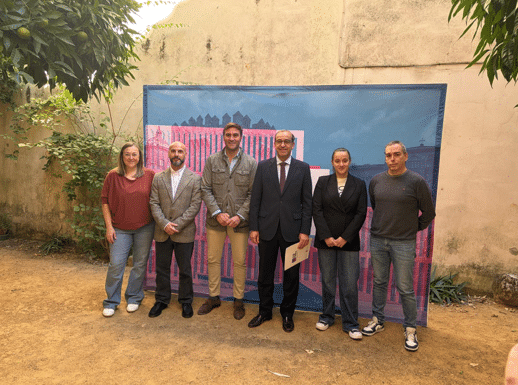
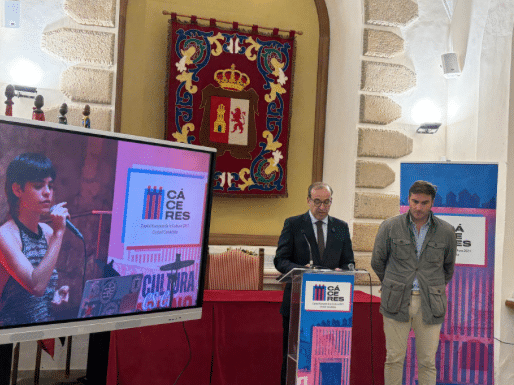
The mayor of Cáceres and president of the Cáceres 2031 Consortium, Rafa Mateos, accompanied by the Councilor for Culture, Jorge Suárez, and members of the bid’s technical team, presented the main lines of the document and thanked the institutions, the cultural sector, artists, creators, associations and citizens for their involvement.
“This project was born in Cáceres, but it has to reach and radiate throughout Extremadura,” said Mateos, who highlighted the joint commitment of the Government of Extremadura, the councils of Cáceres and Badajoz and the City Council of Cáceres.
The mayor has defined Cáceres 2031 as “an authentic, very realistic, consensual, transversal and very close to the terrain” candidacy, based on existing talent, heritage and its own methodology of cultural participation and cooperation.
That methodology is Trascultura, summarized in three concepts: listening, connecting and transforming. Listen to citizens and cultural professionals; connect knowledge, ideas and experiences; and transform those relationships into projects, learnings and new opportunities.
In this sense, he has pointed out that the international projection of this model is already generating interest as demonstrated by the fact that the coordinator of the bid, Iris Jugo, is participating these days in Berlin in an international forum to which Cáceres 2031 has been invited to explain Trascultura and its possible application in other countries. “From Cáceres we are telling Europe, without complexes, that from the periphery we have a lot to contribute to culture and to the European fabric,” Mateos stated.
The programming presented in the dossier is structured into 12 programs grouped into three main axes: Earth, focused on heritage, landscape and received knowledge; Path, which puts people, ideas and culture in motion; and Encuentro, oriented towards coexistence, care and community building.
The bid currently includes 60 initiatives, although it will continue to grow until 2031 through open calls that will allow the incorporation of new artists, groups, institutions and proposals.
The project is also developed through four large structures: Rural Labs, with residences and creation experiences linked especially to the rural environment; Diversitas, focused on accessibility and participation; Awakenings, which connects the arts with care and human relationships; and Generation 31, which will give prominence to children, adolescents and young people in cultural creation.
Added to this is Trascultura Academy, a training tool designed to facilitate the development of projects with European partners, interdisciplinary and intergenerational work and the generation of knowledge that remains in the territory.
Mateos has also highlighted the work already carried out by the Cultural Activation Office and by the volunteer network linked to Cáceres 2031.
A bid connected with Europe
The European dimension is one of the pillars of the project. Cáceres 2031 participates in international networks linked to culture and maintains collaborations with various cities involved in European Capital of Culture processes.
These include Évora 2027, Liepāja 2027, Leuven 2030 and Victoria 2031, as well as partners in countries such as Montenegro, Sweden, Romania and Slovakia. “European cooperation does not have to be just on paper; it has to be in reality and in facts,” said the mayor.
Mateos has stressed that one of the keys of the project is that the bid is not only based on what will be done in the future, but that it has already generated transformations that will remain beyond the final result. “We can say without hesitation that Cáceres and Extremadura have already won with this race towards 2031,” he stated.
For this reason, he has been “optimistic” and “convinced” that Cáceres will be the European Capital of Culture in 2031.
Upcoming milestones
After the registration of the bid book, Cáceres 2031 now faces the decisive dates of the process. On November 9 and 10, a meeting on the role of artists and culture in the European Union will be held in Cáceres.
On November 23, the city will receive a visit from experts in charge of evaluating on the ground the content of the dossier, the infrastructure and the social commitment to the candidacy. On November 30, Cáceres will officially defend his project before the jury and finally on December 3, the announcement of the Spanish city chosen as European Capital of Culture 2031 is scheduled.
“We are going to defend our project with simplicity, but with the utmost professionalism; with respect for the process and the rest of the candidacies, but also with optimism and with the confidence that we have the best project to be European Capital of Culture in 2031,” Mateos concluded.
The objective, he added, is that this entire process translates into “a more open and participatory cultural life, an even more prepared sector and greater opportunities for Cáceres society and for all of Extremadura.”