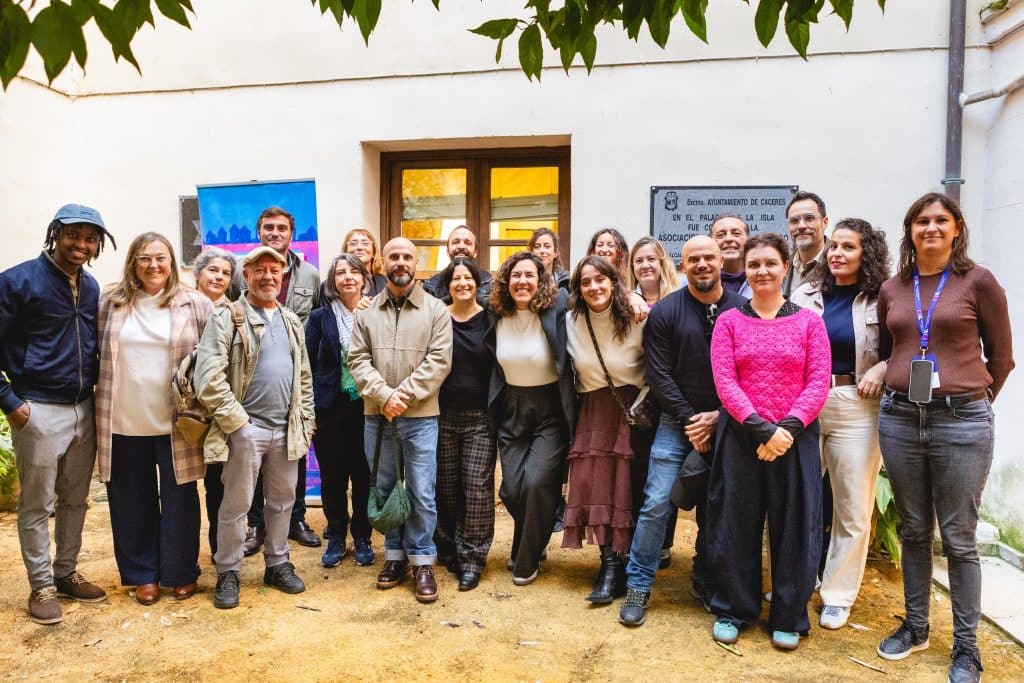
- The two-day event, taking place today and tomorrow in Cáceres, brings together cultural professionals, local communities and experts from across the sector
- The experiences of Leuven 2030 and Victoria 2031 will take centre stage tomorrow during the second day of the event, organised in collaboration with MAE
Cáceres 2031, the initiative behind the city’s bid for the European Capital of Culture title, has brought together cultural organisations, local communities and European experts today to connect talent from Cáceres and Extremadura with other territories and work towards building a lasting cultural legacy, starting now.
Iris Jugo, General Coordinator of Cáceres 2031, highlighted these objectives at the opening of The Culture of Europe’s Future (ECoCs), a two-day international event bringing together cultural professionals, representatives of European projects and experts in artistic creation and citizen participation to reflect on the role culture can play in shaping Europe’s future.
Jugo explained that the event brings together the cultural sector, local communities and European Capital of Culture experts to discuss “what role culture plays in Europe’s future” and learn from cities that have already held the title or are preparing to do so. She noted that the gathering offers an opportunity to consider what kind of legacy should be built from this moment onwards, how cultural and artistic organisations can contribute, and what Cáceres hopes to gain from and contribute to the European Capitals of Culture.
The General Coordinator also linked the event to the work recently carried out in Berlin as part of A Soul for Europe, focusing on identity and the art of belonging. As she explained, the aim is to bring the insights and lessons from those discussions to Cáceres “so that the conversations continue, are not lost, and become increasingly fruitful and far-reaching.”
Jorge Suárez, Councillor for Culture at Cáceres City Council, emphasised that Transcultura “has evolved from a concept into a methodology”, designed to connect territories, experiences and projects, strengthen the city’s cultural ecosystem and extend its reach beyond the region.
Suárez stressed that the talent of Cáceres and Extremadura deserves to reach Europe and underlined that “now is the time to connect Europe with Cáceres.” In this context, he linked the exchange of experiences to local projects and the ambition to bring together “the European Capital of Culture bid and the future we want for 2031.”
The event is being held in collaboration with the Muestra Ibérica de Artes Escénicas (MAE – Iberian Performing Arts Showcase) and features representatives from Leuven 2030 (Belgium) and Victoria 2031 (Malta), who are sharing their experiences of the European Capital of Culture process. Professionals and organisations working in European cultural cooperation are also taking part.
Until tomorrow, Cáceres will serve as a space for exchanging experiences and working together on issues such as culture’s ability to transform communities, opportunities for cooperation between European territories and the importance of increasing public participation in cultural decision-making.
The event follows the Transcultura methodology, which underpins the Cáceres 2031 bid and encourages listening, connecting experiences and transforming shared learning into new opportunities for action. The aim is to develop concrete proposals and establish cooperative relationships that can continue beyond these two days.
Two days to share experiences and develop proposals
Today’s opening session featured Scottish cultural practitioner Simon Sharkey, Artistic Director of The Necessary Space and one of the founding directors of the National Theatre of Scotland, who shared his international experience of developing artistic projects with communities around the world.
Irene Palomino, Director of the Extremadura Delegation in Brussels, also took part, reflecting on Extremadura’s relationship with Europe and the role European integration has played in the region’s development and international profile.
The collaboration with the Muestra Ibérica de Artes Escénicas (MAE) was reflected in the panel discussion No Borders, No Curtain: Performing Arts Connecting Europe, where theatre, dance and circus professionals explored opportunities for cooperation between territories and the international circulation of cultural projects. The panel featured Simón Ferrero, President of Extremadura Teatral; Elena Gómez Guerrero, from the Association of Dance Professionals of Extremadura; Roberto Calle Martín, from the Association of Circus Professionals of Extremadura; and Toni Álvarez, Cultural Manager at AGCEX.
The programme also included a participatory workshop organised by CAE Spain Hub and facilitated by Fernanda Bilbao, which explored how European cultural policies can help advocate for and sustain cultural ecosystems.
Experiences from Belgium and Malta to take centre stage on the second day
The event will resume tomorrow at 9:00 a.m. at the Ateneo de Cáceres. One of the highlights of the second day will be the participation of Kathryn Cops, from the LOV2030 – Leuven & Beyond team, who will present the experience of the Belgian city, designated European Capital of Culture 2030. Her contribution will explore how culture can help address challenges such as social polarisation and climate change by engaging citizens in the development of a shared project.
Ariane Bieou, representing Victoria 2031 Għawdex (Malta), the city recommended for designation as European Capital of Culture 2031, will also take part. She will share lessons learned from her experience with Matera 2019 and explain how these are being applied to the development of Victoria 2031’s cultural project.
Both experiences will be brought into dialogue with Cáceres 2031 during a public discussion aimed at identifying shared challenges and exploring new opportunities for cooperation between the three territories.
The event will conclude with a collaborative workshop in which participants will work on a roadmap outlining key conclusions and potential future actions. Through this process, Cáceres 2031 aims to ensure that the relationships and proposals emerging from the gathering can continue to develop and contribute to the cultural development of the region.