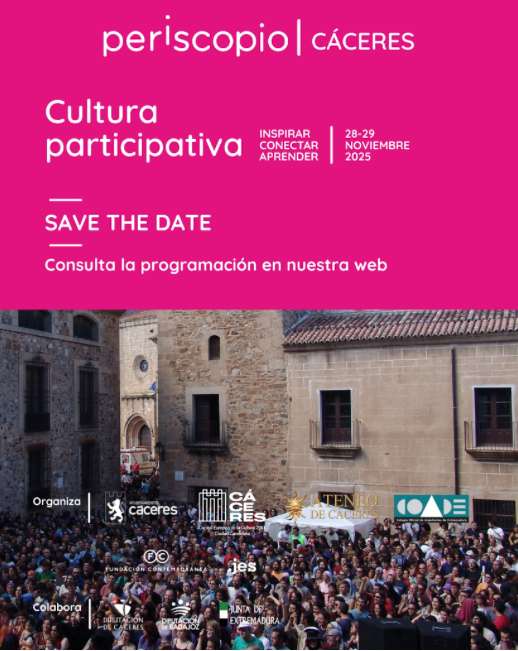
- The event, to be held on November 28th and 29th at the Ateneo, will be a forum for reflection, learning, and collective creation around new models of cultural and civic participation
- Participants will include prominent figures from the national and international cultural scene, such as Sara Magán, director of Fundación Contemporánea; Simon Sharkey, director of The Necessary Space; Antonio Lopes, director of the Tremor Festival (Portugal); and Pamela Calsow, co-founder and cultural manager of the Corporación Amigos de Panguipulli (Chile)
Cáceres will host the ‘Periscopio Cáceres: Participatory Culture’ event on November 28th and 29th. This event is part of Cáceres’ bid to become the European Capital of Culture in 2031 and has been organized in collaboration with the Fundación Contemporánea. It is expected to draw around one hundred young people interested in culture and creative expression and will serve as a forum for reflection, learning, and collective creation around new models of cultural and civic participation.
The event will be held at the Ateneo de Cáceres and is part of the bid’s work program, focusing on two of its strategic pillars: intergenerational dialogue and the active involvement of young people in shaping Cáceres’ cultural project. From this perspective, “Participatory Culture” aims to create a space for young creators, cultural agents, institutions, and citizens to meet, fostering the co-creation of ideas, the exchange of experiences, and the exploration of new ways for culture and community to connect.
Periscopio is an initiative of the Fundación Contemporánea that serves as a meeting place for cultural professionals. Since its inception, it has established itself as an essential event for strengthening the local cultural fabric and connecting managers, artists, institutions, entrepreneurs, media, students, and audiences from across Spain and Europe. Several editions have already been held in cities such as Valencia, Málaga, and Granada.
In Cáceres, the program will offer two intensive days of practical workshops, training sessions, group activities, and urban events designed to foster collective creativity. Among the offerings are sessions on cultural communication, project design, and European funding opportunities, as well as participatory tours of the city and spaces for presenting emerging initiatives. The goal is to strengthen the capabilities of the local cultural sector and foster a collaborative network between generations and diverse sectors.
The program will bring together leading figures from the national and international cultural scene, including Sara Magán, director of Fundación Contemporánea; Simon Sharkey, director of The Necessary Space; and Antonio Lopes, director of the Tremor Festival (Portugal). and Pamela Calsow, co-founder and cultural manager of the Friends of Panguipulli Corporation (Chile).
According to the candidacy coordinator, Iris Jugo, “Periscopio Cáceres embodies the spirit of the candidacy: a city that engages in dialogue, shares, and trusts its youth to shape its cultural future. Youth participation is not a supplementary element, but a central component of the Cáceres 2031 project.”
With initiatives like this, the candidacy reaffirms its commitment to a vision of culture understood as an engine of sustainable development, social cohesion, and citizen participation. Cáceres 2031 is thus advancing in the consolidation of an open, inclusive, and co-responsible cultural model, in which creativity and collaboration become fundamental tools for imagining the city of the future.
Registration for the ‘Participatory Culture’ event is open to young creators, cultural professionals, associations, collectives, and interested citizens. All information about the program and the application form is available on the project’s official website: https://periscopio.fundacioncontemporanea.com/encuentro/cultura-participativa/
About Fundación Contemporánea
Founded by La Fábrica in 2008, Fundación Contemporánea aims to contribute to the development of cultural professionals through networking and training activities, support for entrepreneurs, and the promotion of collaboration between public and private cultural organizations.