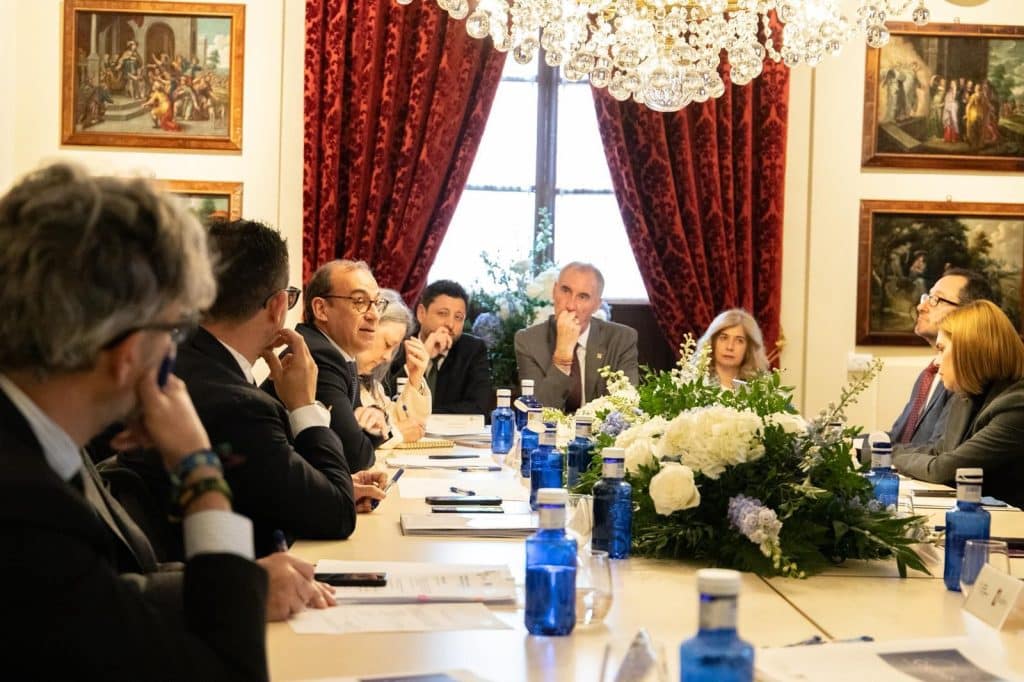
- The Group held its General Assembly in Cáceres, where measures were approved to boost tourism promotion and initiatives relating to heritage
- In addition to international tourism campaigns, there will be significant investment in culture and collaboration with universities to promote heritage conservation
- The Group’s Assembly has approved its budget, which amounts to €1.6 million for 2026
On Saturday, Cáceres hosted the General Assembly of the Group of World Heritage Cities of Spain, at which its president, José Mazarías, expressed the Group’s “firm” support for Cáceres’ bid. The entire Group of World Heritage Cities has decided to express its firm support for Cáceres’ bid to become European Capital of Culture 2031.
The Group’s president noted that “the mayor of Toledo was the first to offer his congratulations after being eliminated from the running and to ask for the support of all the cities”, emphasising that “the Assembly has agreed to express its firm support for Cáceres’ bid to become European Capital of Culture 2031”.
He also noted that “we would be delighted to return to Cáceres to enjoy the wide range of activities taking place in the city”, adding that “we will do whatever is required of us to support this bid”.
For his part, the mayor, Rafa Mateos, expressed his gratitude for the backing received from the Group, highlighting the importance of this support in the bid process: “For us, it is essential to have the support of all the heritage cities, which strengthens Cáceres’ bid to become European Capital of Culture 2031”.
Mateos emphasised that hosting the Assembly in the city “provides an opportunity to showcase Cáceres’ cultural and heritage potential”, as well as to continue forging partnerships that will help drive new initiatives.
He also emphasised that this support “helps to consolidate an ambitious vision for the city, based on culture, heritage and international reach”.
MEASURES APPROVED BY THE ASSEMBLY
The Assembly has approved the organisation’s main strategic priorities for the coming months, as well as the budget for 2026, which amounts to €1,628,091.
The meeting brought together mayors and representatives from the 15 cities that make up the Group, establishing itself as a key event for coordinating common policies on culture, tourism and heritage conservation.
The Group’s president, José Mazarías, emphasised that this budget, funded mainly by contributions from the cities, “demonstrates our cities’ firm commitment and dedication to a shared project that showcases our heritage and strengthens its national and international profile”.
As for the breakdown of expenditure, the Culture department accounts for the largest share of investment, with €549,300 allocated to established initiatives such as Heritage Nights (which will be held over two days for the first time), the Running Circuit and the rugby tournament, as well as new joint cultural projects.
In addition, there is a budget of €280,000 for international tourism promotion, with initiatives planned in cities such as Milan, Rome, Mumbai and The Hague, and €243,000 for heritage-related activities, including specialist conferences, publications and collaboration with universities.
Among the measures adopted, particular note should be taken of the strengthening of the Group’s organisational structure through the recruitment of new staff in strategic areas such as communications, social media, and cultural and tourism management, with the aim of improving operational capacity and addressing future challenges.
In the cultural sphere, efforts will be made to update the exhibition “World Heritage Cities: 15 Jewels of Spain”, incorporating new works dedicated to Úbeda and Baeza, thereby completing the Group’s current representation and strengthening its cultural profile.
The Assembly has also agreed to take forward its collaboration with universities in the 15 cities through a meeting scheduled for April, at which research projects addressing common issues in historic town centres will be discussed.
It has also been decided that the Group’s next General Assembly will be held in July in Tarragona, where the chairmanship will be handed over, as is the case every year in alphabetical order.
The meeting held in Cáceres was attended by the Mayor of Alcalá de Henares, Judith Piquet Flores; the Mayor of Ávila, Jesús Manuel Sánchez Cabrera; the Councillor for Heritage and Culture of Baeza, Ignacio Montoro Fernández; the Mayor of Cáceres, Rafael Mateos Pizarro; the Mayor of Córdoba, José María Bellido Roche; the Mayor of Ibiza, Rafael Triguero Costa; the Councillor for Tourism of Mérida, Felipe González Martín; the Mayor of Salamanca, Carlos Manuel García Carbayo; the Mayor of San Cristóbal de La Laguna, Luis Yeray Gutiérrez Pérez; the Mayor of Segovia, José Mazarías Pérez; the Mayor of Tarragona, Rubén Viñuales Elías; the Councillor for Tourism of Toledo, José Manuel Velasco Retamosa; and the Mayor of Úbeda, Antonia Olivares Martínez.