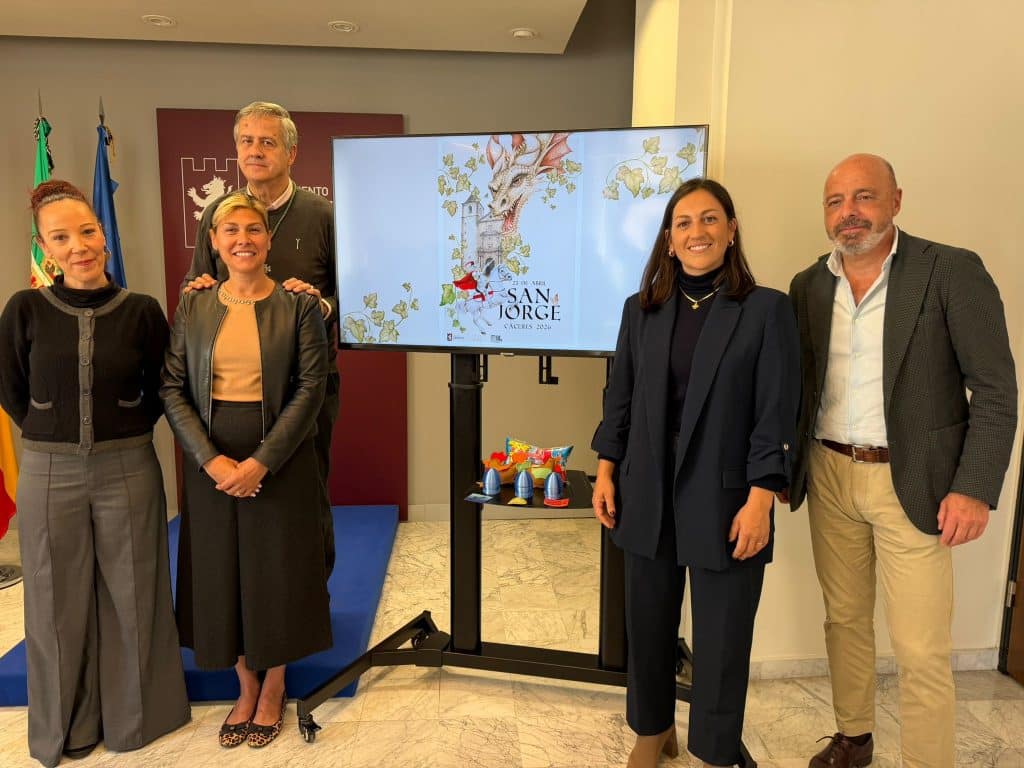
- The council is throwing its full weight behind this major event and has packed it full of new features, such as handing out identification wristbands and sweets to the children taking part
More than 3,100 people and 27 dragons will take part in one of the most eagerly awaited events for people of all ages in Cáceres: the St George’s Day parade. This year there are several new features to the celebration, such as the distribution of identification wristbands by the local police; once the parade has finished, the children taking part will be given a special bag of gluten-free sweets; and in addition to the golden hens, three blue eggs will be hidden this year.
The Councillor for Festivals, Soledad Carrasco, presented the programme of events alongside the Councillor for Safety, Pedro Muriel; Alonso Corrales from the San Jorge Fraternal Association; Rocío Barahona from Atakama Creatividad Cultural; and Raquel Preciados, the 2026 San Jorge Festival Announcer.
Regarding the poster, she explained that it is the work of the Extremaduran designer and illustrator Natalia Cerón, “a design in which she reinterprets the legend from a poetic and symbolic perspective. The dragon emerges from the architecture of Cáceres, blending myth and reality and reinforcing the city’s identity. The figure of Saint George on horseback introduces dynamism and narrative tension, whilst the ivy evokes the passage of time and nature’s mark on the historical heritage”.
Subtly integrated into the typography, “a hen with ochre and golden plumage appears, alluding to the legend of the Caíd’s daughter, who was bewitched and remains present in the popular imagination during the festival”; as for the technique, “the work combines watercolour and coloured pencils. The watercolour lends an ethereal atmosphere, reminiscent of the ancient tale, whilst the coloured pencil reinforces the details and accentuates key elements such as the dragon. The composition is completed digitally, achieving a visual balance that bridges the traditional and the contemporary, championing the value of craftsmanship in today’s context”.
At the parade, “we will have more than 3,100 people parading through the town, including the procession accompanying the town’s giant dragon, which will be 14 metres long”.
This year’s event includes some significant new features, Carrasco explained. “The first is the distribution of identification wristbands by the local police. Just as we did during Holy Week – and, incidentally, to great acclaim – these will be handed out so that parents can put them on their children before the parade, making it easier to locate them quickly and providing greater peace of mind.”
The official parade will take place on Wednesday 22 April. It will start at 7.00 pm from Ronda de la Pizarra and follow the usual route: Avenida de la Hispanidad, Avenida Isabel de Moctezuma (with a section near DYA and Caixabank reserved for people with reduced mobility), Calle Sánchez Manzano (an inclusive section for people with hearing impairments), Avenida Antonio Hurtado, Plaza de América, Avenida de España (odd-numbered side), where there will be another section for people with reduced mobility near the Residencia Ciudad Jardín, Calle San Antón, Calle San Pedro, Plaza de San Juan, Gran Vía, Plaza Mayor and San Blas. The entire parade can be followed live at tusemanasanta.com
As a new initiative, “and to recognise the efforts of the children who take part with such enthusiasm, the City Council will hand out a special bag of gluten-free sweets to all of them in San Blas once the parade has finished. This bag, designed for the occasion, will also include a 2031 Cultural Capital wristband. It will be a small prize to help them recharge their batteries whilst they watch the burning of the dragon in the Plaza Mayor live on the giant screen set up in San Blas.”
At 10.00 pm, in the Plaza Mayor, the Atakama theatre company will perform *The Legend of St George*. As in previous years, a giant screen will be set up in the Plaza Mayor so that everyone can watch the performance, and once St George has slain the dragon, there will be fireworks and the traditional hunt for the golden hens will begin.
Regarding the “Find the Hen” competition, the councillor highlighted that “this is an initiative that attracts a growing number of visitors every year and which also features some new elements this year. That same evening, two hens will be hidden in the historic city centre, in easily accessible locations, each with a prize of 200 euros”, and furthermore, this year three blue eggs will be hidden, “each with a 50-euro voucher to be redeemed at Fiestas Kike, El Reino de las Chuches and Retales Manolo”.
She reminded everyone that the hens and eggs must be handed in at the Festivals Department, “where the payment will be processed and the vouchers issued. And, of course, they must never be hidden in private spaces such as gardens or homes”.
Continuing with the programme, on Tuesday 21st at 11.00 am, the San Jorge Fraternal Association will carry out the transfer of the banner, with the flag-raising ceremony scheduled to take place at the Town Hall at around 11.20 am.
At 12 noon, in the Plenary Hall, the 13 winners and finalists of the traditional St George’s Day drawing competition will be announced. They will all receive a gift provided, once again this year, by Juguetes Ávila and Toy Planet, whom we would like to thank for their support and commitment to this activity, which is so important for the children. This year, 735 pupils in Years 1 and 2 from all the city’s schools took part.
She added that, as a new feature, “one of the drawings will be exhibited at the Palacio de la Isla. Although the artist was unable to enter the competition because they exceeded the age limit, it is a piece that deserves to be shown”. Furthermore, as agreed last year in consultation with the schools, the dragon competition will not take place, “and instead, the €5,000 prize money will be distributed among all the groups registered for the parade, with the aim of encouraging participation and creativity without pressure”.
This year’s opening address will be given by Raquel Preciados Penis, director of the Cáceres Museum, and will take place on Saturday 18 April at 8.00 pm in the Co-Cathedral of Santa María.
In addition, a programme of events has been organised at the Cáceres Museum, along with sporting activities to mark the city’s patron saint’s day, such as the now traditional San Jorge National Show Jumping Competition at the Monfragüe Equestrian Club on 24, 25 and 26, with free admission “to enjoy this major equestrian event, which will feature leading national figures”.
On 23 April, the St George’s Day celebrations will take place, featuring a civic procession from the Town Hall at 11.50 am; a Mass at the Co-Cathedral at 12 noon; and the laying of a wreath at the statue of St George, following the lowering of the banner. There will also be a tribute to retired municipal workers in the council chamber at 1 pm.
Carrasco expressed her gratitude for “the work of all the municipal departments, the local police, the associations, the schools, the sponsors, the company organising the parade and the performance, and everyone who helps ensure that this festival continues to grow year after year. Without their involvement, it would not be possible”.
Parade and town crier
Barahona pointed out that it is difficult to innovate, “but Cáceres is making it easier and easier for us because there are so many schools and associations that want to take part. A new feature of the parade will be the Catholic Monarchs walking on stilts, accompanied by a group of court jesters. The dragon will have a fierce appearance, and the colours will be shades of red with touches of ochre and gold.”
The play is set to premiere; “we change it every two years. We’re going to stay very true to the legend. The title is ‘San Jorge la leyenda’ by Miguel Ángel Latorre Caballero, quite an ensemble piece, with nine lead actors, all from Cáceres, championing local culture and that of Extremadura, as all the companies working with us are from the region. We have a very strong Mansaborá and we’re going to highlight the role of women.”
Corrales explained that they have been working on the history of Saint George for 12 years: “We continue to give talks, we’ve visited schools, and two publications have been produced. We share the costs of the opening speech 50-50 with the City Council; we’ve found an ideal venue in Santa María, and we propose the speakers. We have been piecing together small fragments of history that had been lost in Cáceres, which complement the historical figure of the city’s patron saint very well, so that children can learn about the history. Associations dedicated to Saint George in other cities have shown interest, and we are trying to build a network around the historical figure of Saint George.”
Preciados expressed her gratitude for the honour of being the festival’s official herald: “I’m very excited, and it’s going to be a speech straight from the heart. At the same time, the museum is organising a programme of events to complement the others, and it’s fantastic that we’re all following the same plan, because the figure of Saint George is very important to the city, and this helps to raise awareness and ensure historical accuracy.”