- The two municipalities are exploring the possibility of Potries joining Rural Labs, one of the strands of Cáceres 2031, and potentially leading a first pilot experience of cooperation between small municipalities in Spain and Europe
- Potries’ experience, as Valencian Capital of Culture in 2018 and later as a candidate for European Capital of Culture, will serve as a reference for exploring citizen participation, shared governance and cultural development from rural territories
Cáceres and Potries have opened a new line of collaboration to explore models of cultural cooperation between rural territories within the framework of Cáceres’ bid to become European Capital of Culture in 2031.
Potries is a Valencian municipality with just over 1,000 inhabitants that submitted a bid for the European Capital of Culture title. Although it was not selected for the final stage, the Cáceres team saw from the outset considerable potential forcreating synergies and developing joint projects, building on the strong commitment to rurality shared by both bids.
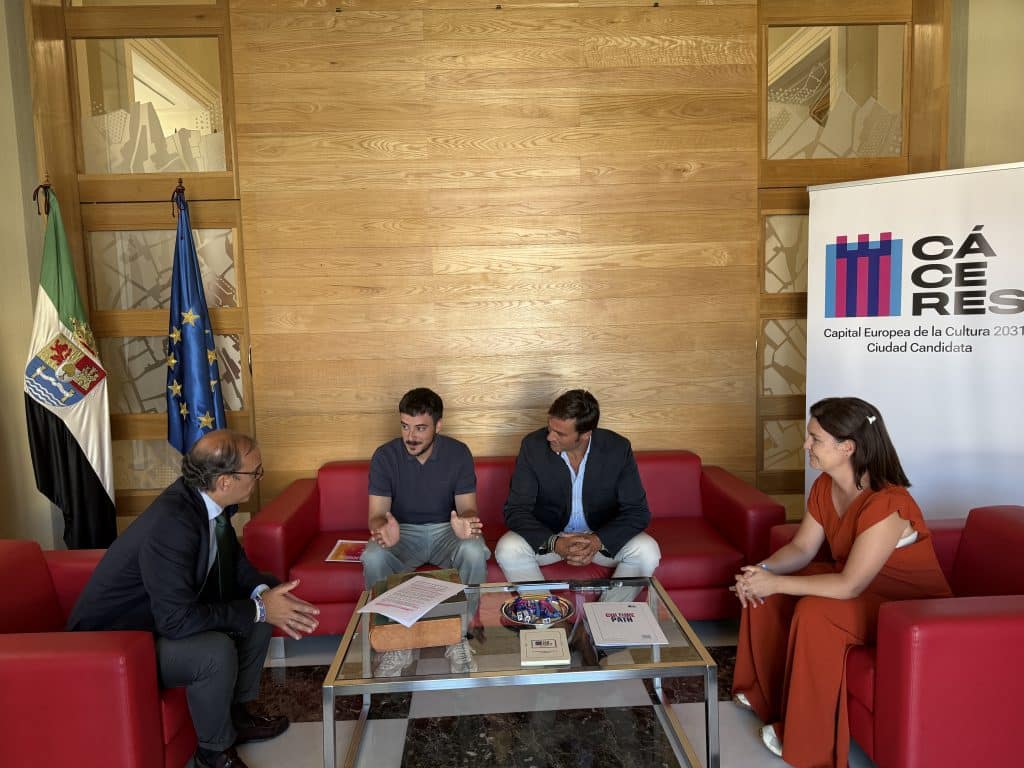
The collaboration was first discussed at a meeting between the Mayor of Potries and the Cáceres 2031 technical team, followed by a meeting between the mayors of the two municipalities, Sergi Vidal and Rafa Mateos, respectively. Cáceres Councillor for Culture Jorge Suárez and Cáceres European Capital of Culture 2031 Consortium Coordinator Iris Jugo also took part. The meeting provided an opportunity to examine the experience developed by the Valencian municipality and the possibilities of incorporating it into the different strands of the Cáceres bid.
Potries was named Valencian Capital of Culture in 2018 and later submitted its bid for European Capital of Culture. Its journey is of particular interest to Cáceres 2031 because of the way it has used culture as a tool for territorial transformation and demonstrated the ability of small municipalities to develop cultural strategies, participation, innovation and cooperation beyond the limits of their geographical scale.
The process undertaken by Potries has enabled the municipality to strengthen its cultural strategy, develop new capacities and partnerships, and explore models of shared governance involving institutions, citizens, the cultural sector and other territories. For Cáceres 2031, this experience demonstrates that the value of a European cultural bid lies not only in its final outcome, but also in the capacities, relationships and ways of working that remain embedded in the territory.
Rafa Mateos thanked Potries for its willingness to collaborate, highlighting that this approach is closely aligned with the work already being carried out by Cáceres 2031. “We are showing that culture is not made only in large cities, that culture can also be created in small municipalities, and that it should not be driven solely by public administrations, but also by civil society,” he said. “This exchange will undoubtedly mark a turning point for the Cáceres bid and provide an importantboost to Potries’ cultural project,” he added.
Potries as a potential Rural Labs partner
The collaboration that Cáceres 2031 aims to explore with Potries falls within Rural Labs, one of the tools developed by the bid to turn rural territories into spaces for learning, experimentation and cultural cooperation.
The initiative is based on the principle that rural municipalities should not be limited to receiving cultural programmes designed in cities. Instead, they should have the tools and capacities to identify their own challenges, build strategies, encourage citizen participation, establish partnerships, and design and lead cultural projects.
Between 2027 and 2031, Rural Labs aims to develop capacity-building and experimentation processes specifically designed to create lasting capabilities within these territories.
The initiative also responds to the particular characteristics of the Cáceres bid. Cáceres 2031 is rooted in a city whose historic centre is a UNESCO World Heritage Site, while also forming part of a predominantly rural territory facing challengesrelated to demographics, territorial cohesion, access to culture, citizen participation and the creation of opportunities. Added to this are Extremadura’s peripheral location and its proximity to and historic relationship with Portugal, makingcooperation between territories and the cross-border dimension central elements of the project.
A pilot programme for cooperation between small municipalities
Within Rural Labs, Cáceres 2031 is working on the design of a pilot initiative provisionally called Horizon Rural, conceived to bring to cultural cooperation between small municipalities a model based on identifying shared challenges, creatingconsortia between territories and fostering shared leadership.
The initial proposal envisages each project bringing together between three and five Spanish municipalities from at least two different autonomous communities. They would be joined by between one and three European municipalities orpartners, giving each project an international dimension from the outset.
Each consortium would focus on a specific challenge, with one of the participating small municipalities taking the lead. The aim is to test a model in which rural territories are not simply recipients of cultural initiatives, but promoters and leaders of interterritorial and European cooperation projects.
In this context, Cáceres 2031 aims to explore with Potries the possibility of the Valencian municipality joining Rural Labs and potentially leading the first Horizon Rural pilot experience.
Its role would have two dimensions. On the one hand, it would enable the knowledge gained through Potries’ cultural journey and its experience as a European Capital of Culture candidate to be shared with other small municipalities. On theother, it would provide an opportunity to test in practice the capacity of a small municipality to coordinate an alliance involving territories from different Spanish autonomous communities and European partners.
The Mayor of Potries said he was “delighted” to continue contributing from the municipality’s own experience and rural perspective, “because Cáceres is already working in this direction, connecting its territory and giving it momentum beyondthe city itself, and we will be there to continue contributing.”
Listen, connect and transform
The relationship with Potries also forms part of Transcultura, the working method of Cáceres 2031, structured around three actions: listen, connect and transform.
The bid sees listening as a tool for identifying experiences and knowledge that already exist within territories; connecting as a means of bringing together municipalities, citizens, professionals and institutions facing shared challenges; and transforming as the necessary step to turn those exchanges into projects, capacities and sustainable change.
The experience of Potries follows this logic: learning from a territory that has already undergone a process of cultural transformation, connecting that knowledge with other municipalities and using it to develop new models of cooperation.
The relationship between the two municipalities also reflects one of the principles underpinning Cáceres 2031: many of today’s cultural, demographic and territorial challenges cannot be addressed by a city alone, but require collaborativenetworks between territories that, despite differences in geography and scale, face similar challenges.
Europe is also built from its villages and small towns
The initiative also connects with the European debate on the future of the European Capitals of Culture and with issues such as the legacy of bids, the sustainability of projects, deeper citizen participation, inclusive territorial development and new models of cooperation between cities and territories.
For Cáceres 2031, this reflection is particularly relevant given the characteristics of Extremadura. The bid seeks to explore what it means to be European Capital of Culture from a predominantly rural, peripheral and border territory, turningthese characteristics into an opportunity to test new relationships between culture, citizens and territory.
The collaboration with Potries seeks to move in this direction while recognising the knowledge and capacity for initiative that already exist within small municipalities. The objective is not to bring culture from major urban centres to rural communities, but to help create the conditions in which rural territories themselves can design, decide on and lead cultural projects, while building partnerships with other places in Spain and across Europe.
From this perspective, Cáceres 2031 sees rurality and peripherality not as disadvantages, but as spaces from which new forms of European cultural cooperation can be tested.