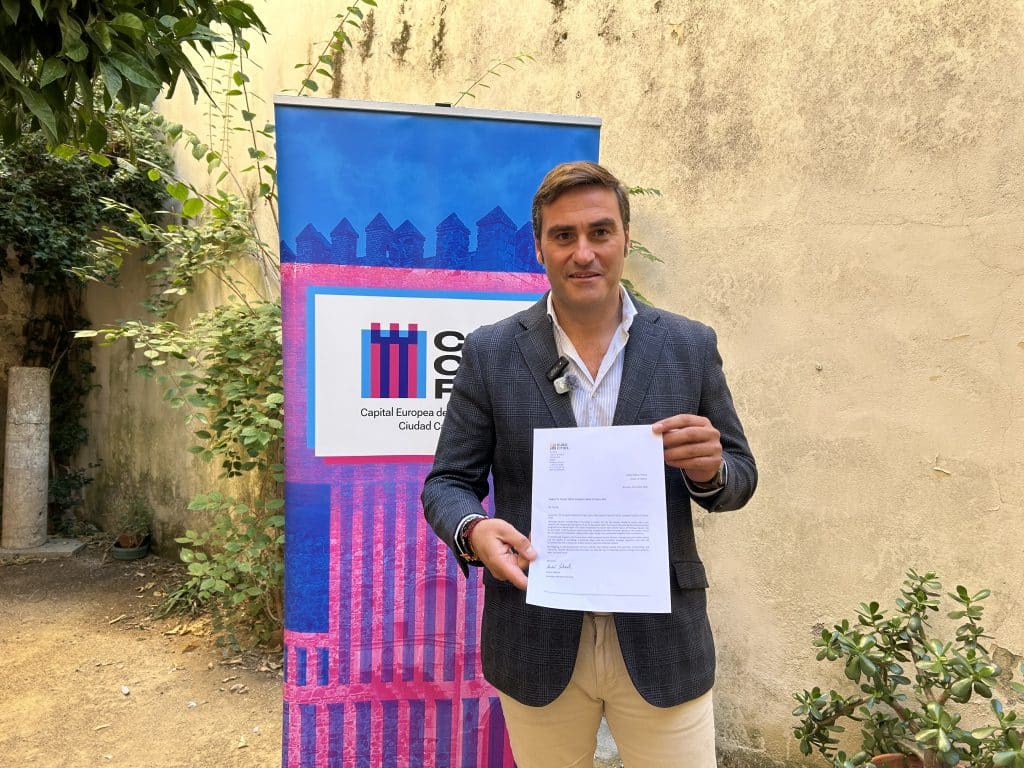
- The organisation, which brings together more than 200 cities from 38 countries and represents over 150 million people, has sent a letter expressing its support for Cáceres’ bid for European Capital of Culture 2031
- Eurocities highlights the Transcultura concept and its commitment to sustainable, inclusive culture that contributes to citizens’ wellbeing
Eurocities, Europe’s largest network of cities, has formally expressed its full support for Cáceres’ bid to become European Capital of Culture 2031. The endorsement comes in a letter signed by its Secretary General, André Sobczak, and addressed to the Mayor of Cáceres and President of the Cáceres European Capital of Culture 2031 Consortium, Rafa Mateos. In the letter, Eurocities acknowledges the bid’s cultural vision and its commitment to sustainability and inclusion.
Eurocities brings together more than 200 cities from 38 countries, both within and outside the European Union, representing over 150 million people. The organisation connects more than 6,000 local politicians, officials and experts to share experiences, develop joint projects and influence European policies. Its work covers areas such as culture, sustainability, social inclusion, mobility and digital transformation, fostering cooperation between cities to address common challenges.
In its letter, Eurocities expresses its support for Transcultura, the central concept underpinning Cáceres’ bid, and particularly highlights its commitment to sustainable culture that contributes to citizens’ wellbeing. The organisation considers this vision to be fully aligned with its strategic objectives and the Eurocities Lille Call to Action, which promotes a more inclusive and lower-carbon cultural sector in European cities.
A bid connected to Europe’s cultural challenges
This endorsement represents further European recognition of the Cáceres 2031 project and is the result of ongoing collaboration and engagement with Eurocities, particularly during the recent meeting of its Culture Forum in Gothenburg, Sweden, in which the bid team participated.
The organisation also highlights Cáceres’ active involvement in the European network, despite having joined only recently. In this regard, it recalls that in March 2024, the city hosted a peer-learning visit as part of Living Spaces, a European programme funded by Creative Europe. During the visit, the transformation of Plaza de Santiago was presented as an example of citizen-led urban regeneration.
Eurocities notes that this project, inspired by the principles of the New European Bauhaus, serves as a model for collaborative urban design and sustainable neighbourhood revitalisation, transforming a public space into an accessible, multifunctional area open to the community.
In its letter, Eurocities emphasises that, by developing local policies and cultural activities that prioritise sustainability and inclusion, Cáceres demonstrates the important role cities can play in building a more sustainable and inclusive future.
The support of this European network strengthens the international dimension of Cáceres 2031 and reinforces the bid’s ongoing efforts to build partnerships with other cities, exchange experiences and position culture as a driver of territorial transformation.