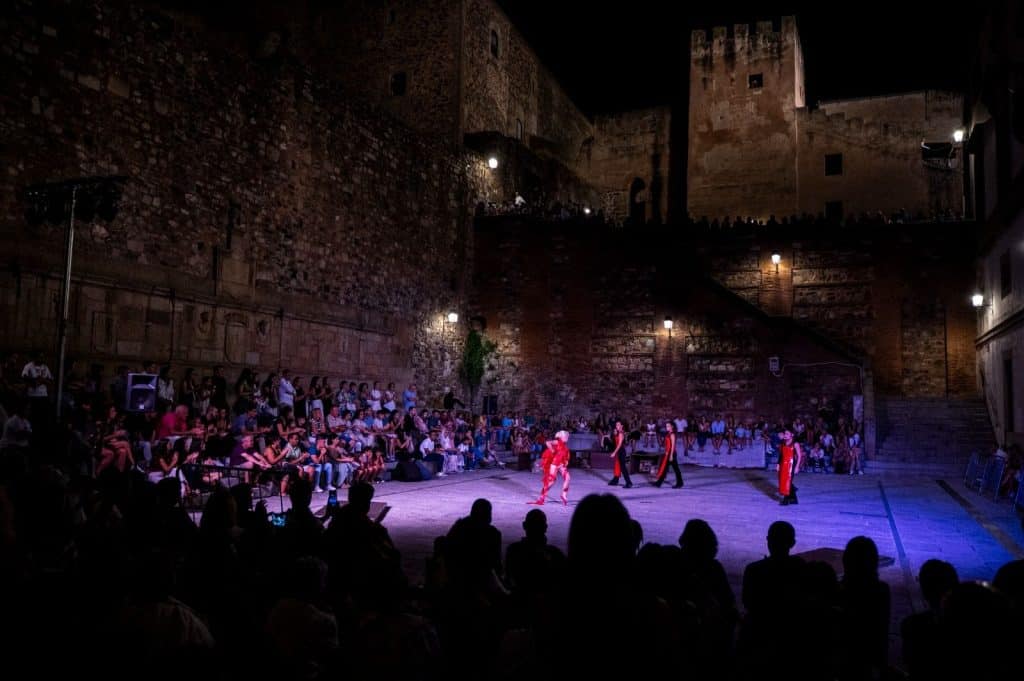
- The Councilor for Culture of the Municipal Chamber of Évora, Carmen Carvalheira, shared during the Heritage Nights the lessons learned from the path towards Évora 2027
- Claims cooperation between two territories united by culture and a shared history
When you think of a European Capital of Culture, it’s easy to look directly at the year next to the city’s name. However, for Carmen Carvalheira, Councillor for Culture in the Évora City Council, much of what’s truly important happens long before that.
Évora knows this well. The Portuguese city was chosen as the European Capital of Culture for 2027 after a long process that began years ago and is now on the verge of holding the title. Carvalheira was recently in Cáceres accompanying Cáceres 2031 during the Heritage Nights, a visit that allowed for the sharing of experiences between two neighboring cities that find numerous points of connection in their respective cultural paths.
The Portuguese experience leaves a first lesson, that a European Capital of Culture cannot be understood solely as a program concentrated over twelve months. It is a transformation process that needs time, participation and the ability to build consensus.
A project that belongs to the city
Carvalheira remembers that Évora’s journey has not been easy either. The candidacy went through the pandemic and subsequently had to face political and municipal changes, in addition to the difficulties inherent to a project of this size.
Precisely those moments forced, he explains, to look beyond the political circumstances and understand the European Capital of Culture as a true “city project.”
This shared character is, for the Portuguese representative, one of the main strengths of Évora’s journey. Culture thus becomes a tool for activating a territory’s identity, connecting its inhabitants, and generating a shared vision for its future.
The approach is also very present in Évora 2027. The European Capital of Portuguese Culture is built around the concept of Wandering, a way of understanding time, relationships and territory that starts from the Alentejo identity itself to dialogue with Europe. Évora and the Alentejo team will share the title in 2027 with the Latvian city of Liepāja.
Cáceres and Évora, closer than the border indicates
During his visit to Cáceres, Carvalheira also emphasized the similarities between both cities. Cáceres and Évora share heritage, history and a territorial position that faces them with similar challenges, from the effects of climate change to the difficulties and opportunities linked to a territory.
But they also share a way of living culture that goes far beyond major events. It is present in gastronomy, in customs, in public spaces and in the daily lives of its inhabitants.
It is precisely there where one of the great possibilities of collaboration between Évora 2027 and Cáceres 2031 appears.
Carvalheira defends the need to understand the border from another perspective. The numerous cross-border projects developed over the years between Portugal and Extremadura demonstrate that both territories maintain much deeper relations than an administrative line can indicate.
In border areas, customs, personal relationships and ways of life mix until communities are built that can hardly be explained solely as Portuguese or Spanish.
Therefore, faced with the possibility of converting borders into spaces of cultural creation, their response is clear. Cooperation between the two sides of the Raya makes it possible to generate new links and explore shared projects from a reality that is already everyday life for many people.
Learn from those who have already walked the path
The relationship with Évora also takes on special significance for Cáceres 2031. While Cáceres continues to build its candidacy to become European Capital of Culture, the Portuguese city is in the phase immediately prior to the celebration of its year.
This time difference allows for a particularly useful dialogue. Évora can share the difficulties, doubts, and lessons learned that have accompanied her candidacy and the years following her appointment, while Cáceres can incorporate that experience into a project that continues to grow and connect with Europe.
Évora’s own career shows that the path does not end when the designation arrives. The city was elected in December 2022 and since then has been working on a project that wants to extend its effects beyond 2027 and reach the entire Alentejo region.
For Carvalheira, this view also forces us to think about Europe from the territories and from cooperation between nearby cities. “Europe is a common territory,” she points out.
An idea that finds an especially close example in Cáceres and Évora. Two World Heritage cities separated by just over a hundred kilometers, united by centuries of shared history and that today meet again through culture.
The presence of Évora in the Heritage Nights of Cáceres was a new example of that relationship. While one city prepares to live its European Capital of Culture in 2027, the other continues to advance towards 2031. A path of collaboration opens between the two in which the border stops being a limit and becomes a place from which to imagine projects together. Because culture is the path.